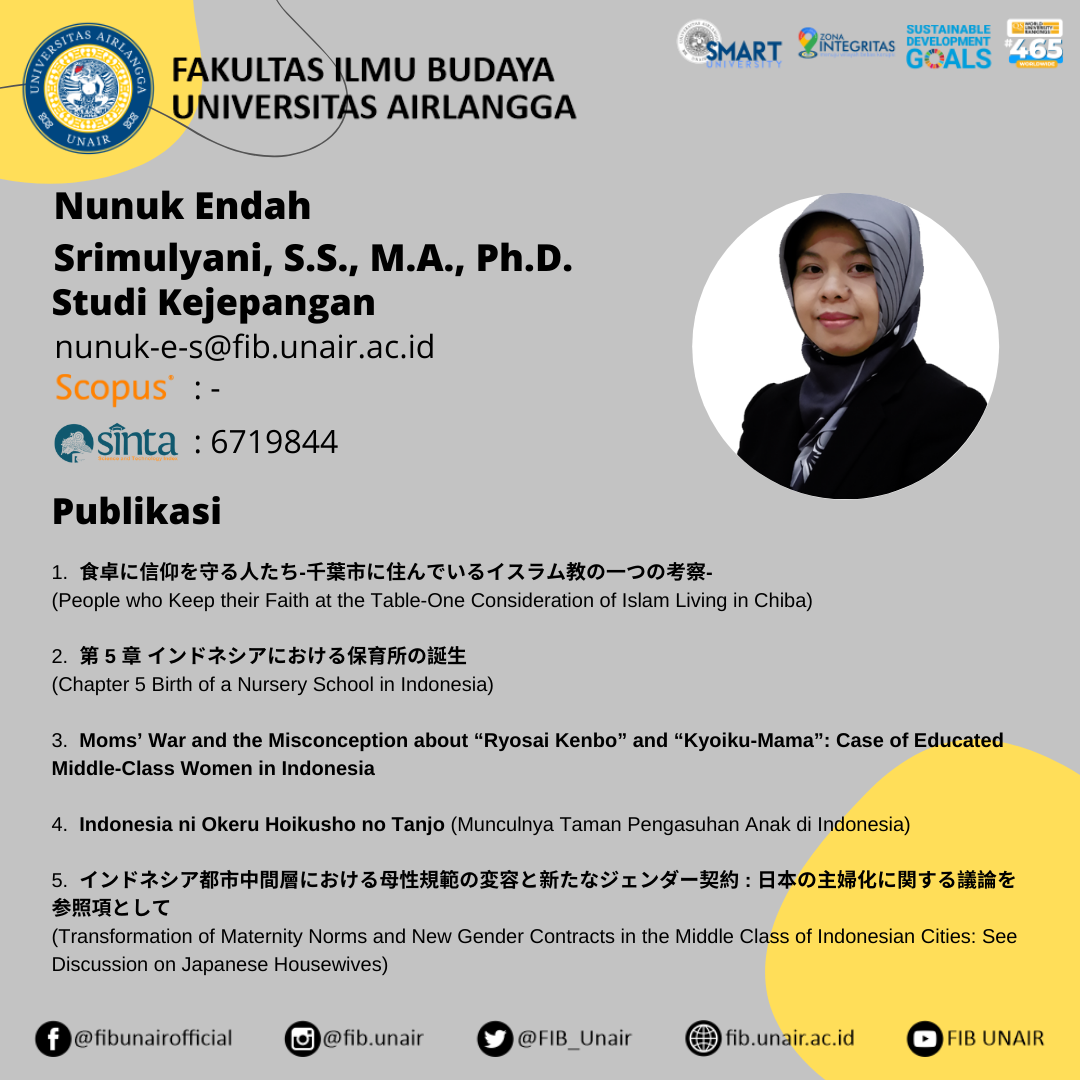
Nunuk Endah Srimulyani, S.S., M.A., Ph.D.
Head of Japanese Langugage and Literature Programme
Welcome!
The Department was founded in 2006 and has made a lot of accomplishment for the last 11 years in terms of teaching excellence brought by lecturers, 36% being those who received their PhD from Japanese universities. In terms of curriculum, this program already implement Indonesian National Standard of Higher Education and National Qualification Framework, in accordance with the instruction of the Ministry of Research, Technology and Higher Education.
The scope of knowledge covered by this program is another unique quality, as it is supported by a range of expertise of its staff members, covering Japanese Linguistics, Translation Studies, Japanese Literature, Media Studies, Japanese History, Japanese Culture and Society, Gender, and Japanese Popular Culture. The diverse range of expertise is comprised by materials used for all academic activities.
Students are encouraged not only to rigorously master the knowledge, but also apply it in practical implementation. This enables the students to gain outstanding achievement in Japanese speech competition (first place in 2014 & 2015 National competition), Kanji competition (first place in 2016 provincial competition), and Yosakoi dance competition (2008 & 2011 champion). Every year, there are 15 students who go to Japan as delegates for 6-12 months Student Exchange Program. There are also several students who go to Japan for internship program in Japanese companies for 3 months. For the past seven years, the students have been holding an event called Japanese World, which starts to gain its reputation in East Java and aims to introduce Japanese Culture to the public.
Thank you for visiting our official website, and we do hope that you find information you need regarding our program.

Vision
To be an independent, innovative, and leading program at national and international levels and to be a center for the development of Japanese Studies, by contributing significantly to the development of knowledge and professionalism in Japanese language, linguistics, literature, and culture based on moral and humanitiy vlues
Mission
To achieve its vision, the Japanese Studies Programme set four missions:
1. To offer academic education in Japanese language, linguistics, literature, and culture, based on modern learning technology.
2. To organize and develope a Japanese Studies programme that is professional and oriented to the satisfaction of internal and external stakeholders.
3. To produce innovative, interdisciplinary scientific works with the theme of the Japanese language, linguistics, literature, and cultural studies, especially those related to urban society.
4. To produce graduates who have expertise in the fields of the Japanese language, linguistics, literature, and cultural studies that can be applied in the fields of business, public service, and society.
Accreditation?
Faculty Member


Graduates Profiles
The main purpose of the establishment of the Japanese Studies Programme, UNAIR, is to enrich the nation through education development and produce graduates who have high morality, high empathy to the society, high knowledge in the fields of Japanese Studies, and good performance, and also good soft skills. By referring to the vision and missions of the Japanese Studies Programme, the graduates of this study programme are expected to be an educator, a communicator, an analyst, an innovator and a manager. The details of the graduates’ profile are: 1) Educator: Graduates are educators who can teach Japanese to Indonesians using the latest Japanese language teaching methods. 2) Communicator: Graduates are communicators with adept Japanese skills, both spoken and written in the fields of academics, professional, and creative industries based on linguistic rules and communicational context. 3) Analyst: Graduates are analysts with the ability of critical and holistic thinking to study linguistics, literature, and cultural phenomena based on the knowledge of the culture of Japanese-speaking communities, also who can think critically so that they have analytical skills in the Japanese field of study and have moral integrity in society. 4) Innovator: Graduates are innovators who can offer solutions to problems in linguistics, literature, and culture. 5) Manager: Graduates are managers who can manage an organization or institution with a variety of different cultural characteristics. They can also provide significant consideration for decision-making. In addition, graduates are managers who have abilities to apply their expertise in organizing work well, can work in teams, and have a leadership spirit based on their Japanese knowledge, experience, and competencies. Moreover, they should also have integrity towards good morals in society as well as competitiveness at the international level.
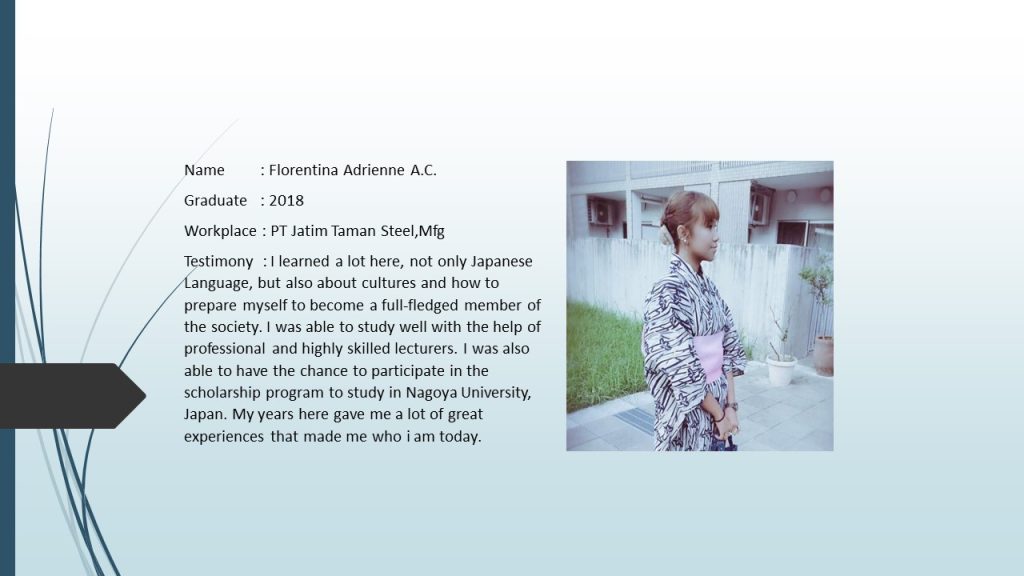
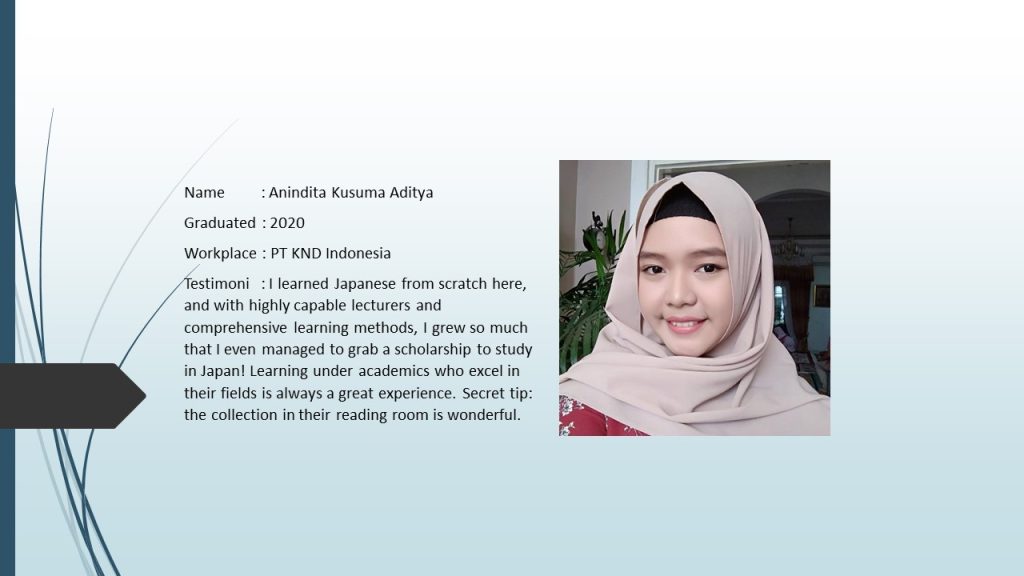
FEATURED ALUMNI